

 USA
 Australia
 Canada
 India
 Malaysia
 UK
 New Zealand
 España
 France
 Indonesia
 Italia
 México
 Deutschland
 中国
 香港
 日本
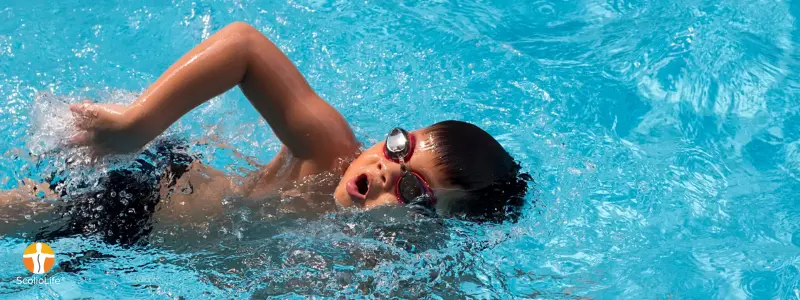
Families with scoliosis are told to take up swimming more often than almost anything else. The research says swimming is good exercise but does not correct a curve, and heavy competitive training is linked with more trunk asymmetry. Here is how to use the pool well alongside a real scoliosis programme.
After a scoliosis diagnosis, one piece of advice reaches almost every family before any other: take up swimming. It comes from family doctors, school nurses, grandparents and online forums, in Singapore and Malaysia as much as in Europe or Australia. The reasoning sounds right. Water supports the body, the strokes use both sides, and there is no impact on the spine.
The research tells a more specific story. Swimming is a healthy activity for a child or adult with scoliosis, and regular sport in general appears to help growing children with mild curves. But swimming does not straighten a curve, and at competitive training volumes it is associated with more trunk asymmetry and a more rounded upper back, not less. This article sets out what the studies found, why a pool cannot do what people hope it will, and how to use swimming sensibly alongside a proper scoliosis programme.
Why swimming is recommended so often
The habit is old. From the 1970s onwards, swimming was the standard posture prescription in much of Europe, and the advice travelled with medical training to Asia and elsewhere. It persists because the logic is intuitive: buoyancy takes the load off the discs and joints, most strokes look symmetrical, the activity builds endurance without jarring, and many people with back discomfort feel better after a swim.
All of that is true, and none of it is the same as correcting a scoliosis. A curve is defined by what the spine does when it is upright, under gravity, for the sixteen or so hours a day a person is awake. Feeling comfortable in water for an hour does not change that pattern. Comfort is not correction.
What the studies actually found
The most cited study is a 2015 cross-sectional study from Italy, published in the Journal of Pediatrics by Zaina, Donzelli, Negrini and colleagues. It compared 112 adolescent competitive swimmers with 217 school students of the same age, around 12 and a half years, using a scoliometer and plumbline, the same tools used in clinic screening. The swimmers were more likely to show trunk asymmetry (odds ratio 1.86), hyperkyphosis, meaning an exaggerated rounding of the upper back (odds ratio 2.26), and hyperlordosis of the lower back (odds ratio 2.24). Female swimmers reported low back pain about twice as often as female non-swimmers. The authors concluded that their data contradicted the common view of swimming as a complete sport and as a treatment for scoliosis.
A 2020 study in the Turkish Journal of Sports Medicine screened 679 adolescent swimmers aged 10 to 18. Twenty-eight had a positive forward-bend test and X-ray-confirmed scoliosis, a rate of 4.1 percent, with average curves of around 14 to 16 degrees. Seventeen were X-rayed again after another year of swimming. No curve had changed significantly in either direction: swimming had neither improved nor worsened the scoliosis.
A 2025 retrospective cohort from Russia followed 54 adolescents with idiopathic scoliosis through scoliosis-specific exercise, with a rigid brace where indicated, until skeletal maturity. Eleven were swimmers. They gained no advantage in curve correction over non-athletes, and they finished with more thoracic kyphosis than the rhythmic gymnasts in the same programme.
The guideline position is consistent with this. The SOSORT 2016 guidelines on conservative scoliosis care state that sport is not prescribed as a treatment for idiopathic scoliosis, while recommending that general sport continue during every phase of care, including bracing, for its physical and psychological benefits. No sport is singled out as corrective, swimming included. In short: no study shows that swimming reduces a Cobb angle, and one reasonably sized study links competitive swimming with worse posture and more asymmetry.
Sport in general is a different story
It would be a mistake to read the swimming evidence as a reason to keep a child with scoliosis away from physical activity. Two large observational studies from the same Italian group point the other way. In 2023, Negrini and colleagues reported on 511 adolescents with curves of 11 to 25 degrees who were still growing (Risser 0 to 2) and had not yet been braced. Over 12 months, those who did no sport were 1.57 times more likely to progress by more than 5 degrees and 1.85 times more likely to cross the 25-degree threshold at which a brace is usually prescribed. Outside elite-level training, the more sessions per week, the lower the risk.
The same group published a 2022 study of 785 adolescents wearing a full-time brace, with a mean curve of 40 degrees. Those who did sport at least twice a week had 1.59 times the odds of improving by 5 degrees or more at 18 months, and the odds rose with frequency. These were mixed sports, not swimming in particular, and observational studies cannot prove cause and effect. The pattern is still useful: an active child does better in a scoliosis programme than an inactive one. Activity supports the result. It is not the programme.
Why a pool cannot correct a curve: the ScolioLife® clinical perspective
What follows is the clinical reasoning Dr Kevin Lau applies at ScolioLife®. It is consistent with the evidence above but goes beyond what the studies directly tested, so treat it as a clinical perspective rather than established fact.
The first point is gravity. Scoliosis is measured, and progresses, in the standing position. In a growing spine the curve is maintained by uneven loading on the growth plates: the compressed side of each vertebra grows more slowly, which tends to deepen the curve, a principle known as the Hueter-Volkmann law. The conservative methods with evidence behind them, bracing and scoliosis-specific exercise, work by changing how the spine is loaded while upright, for many hours a day. Water removes most of that loading. That is why swimming feels so good, and why it cannot teach the spine to hold a corrected position against gravity. When the child climbs out of the pool, the body returns to its habitual pattern.
The second point is that swimming only looks symmetrical. A freestyle swimmer who breathes to one side rotates the trunk the same way with every stroke. Most swimmers have a dominant pulling arm, an uneven kick and a preferred direction for tumble turns. A recreational swimmer repeats these patterns a few hundred times a week; a competitive swimmer repeats them tens of thousands of times. That is a plausible explanation for the asymmetry seen in the Italian study, although the study itself could not prove the direction of cause and effect.
The third point is the shape of the upper back. Freestyle and butterfly strengthen the chest and the muscles that pull the shoulders forward, and high training volumes tend to produce the rounded upper back that swimmers are known for. For someone whose scoliosis already comes with a rotated rib cage, adding uncontrolled kyphosis is not a correction; it is a second postural problem layered on the first.
For these reasons, swimming sits in the same category as cycling or brisk walking in the ScolioLife® programme: encouraged for fitness, stamina and bone health, counted as the general activity the evidence supports, and never substituted for curve-specific exercises or, where indicated, bracing. The time budget matters. An hour in the pool that replaces the daily twenty to thirty minutes of corrective exercise is a loss for the spine, not a gain.
Strokes and habits that matter
No stroke corrects a scoliosis, so the choice of stroke is about comfort, symmetry and avoiding aggravation. The suggestions below are practical clinical guidance rather than findings from trials.
- Recreational swimmers, one to three sessions a week. Swim whatever you enjoy. In freestyle, learn bilateral breathing, breathing every third stroke so the trunk rotates equally to both sides. Mix strokes within a session rather than swimming one stroke for an hour.
- Backstroke is often the most comfortable stroke for a thoracic curve and the one least likely to round the upper back, because the arms work behind the body and the chest stays open.
- Breaststroke and butterfly drive the lower back into extension with every stroke. Adults with a lumbar curve and back pain often find them aggravating; growing children generally tolerate them, but they should not be the only stroke.
- Competitive swimmers, four or more sessions a week. Ask the coach for symmetrical drill sets, both-side breathing and alternating turn directions, and add dryland work for the upper back and shoulder blades. A growing swimmer should have a forward-bend and scoliometer check every six months, because a 4 percent rate of scoliosis in this group is well above the general population and screening takes two minutes.
- Back pain in girls who swim was twice as common in the Italian study. Persistent pain in a young swimmer deserves an assessment rather than more laps.
Swimming while wearing a scoliosis brace
A brace comes off for the pool, and the hours out of it count against the daily total. The brace evidence is dose-dependent: in the landmark BrAIST trial, curves held below the surgical range in around 90 percent of adolescents who wore the brace for more than about 13 hours a day, and the benefit fell away sharply below that. Our article on brace wear time explains why hours matter more than the brace itself.
The practical approach is to plan swimming into the out-of-brace allowance agreed with the clinic, typically a few hours a day depending on the prescription. Keep sessions to about an hour, shower, dry the skin completely, and put the brace straight back on. In humid climates such as Singapore, Malaysia and Indonesia, damp skin under a brace is the fastest route to rashes and to a child quietly leaving the brace off. SOSORT recommends that sport continue during brace treatment, swimming included, as long as it does not erode the wear time that makes the brace work.
Adults with scoliosis and swimming
For adults the question changes, because growth has finished and the goals are pain, function and stamina rather than preventing growth-driven progression. Swimming is a useful low-impact cardiovascular option for adults with scoliosis, particularly for degenerative lumbar curves where walking long distances is uncomfortable. It does not replace strength work for the back extensors, hips and trunk, which is where most adult improvement in pain and endurance comes from. Backstroke and freestyle with bilateral breathing suit most adults; breaststroke, with its sustained neck extension, is a frequent complaint from adults who also have neck pain.
A simple rule for families
If your child has scoliosis and loves swimming, there is no reason to stop, and good reasons to keep them active. Treat swimming as what it is: exercise that keeps a growing body fit, with a known tendency to round the shoulders and favour one side at high volume. Then make sure the curve itself is being addressed by something that works on the spine under gravity, and monitored by someone who measures it. A scoliometer reading every few months, which you can take at home with the free Scoliometer app, will show whether the plan is holding, and our guide to the growth window explains why the timing of that monitoring matters.
Frequently asked questions
Can swimming cure or straighten scoliosis?
No. There is no study showing that swimming reduces a Cobb angle. In the one follow-up study available, 17 adolescent swimmers with scoliosis showed no significant change in their curves after a further year of swimming. Swimming is good exercise, but curve correction comes from scoliosis-specific exercise and, where indicated, bracing.
Is swimming bad for scoliosis?
Not at recreational levels. At competitive training volumes, a 2015 study found swimmers were about twice as likely to show trunk asymmetry and a rounded upper back, and female swimmers reported more low back pain. Competitive swimmers who are still growing should be screened for scoliosis every six months and should pay attention to symmetry in their technique.
Which swimming stroke is best for scoliosis?
No stroke corrects a curve. Backstroke is usually the most comfortable and keeps the chest open, and freestyle with bilateral breathing is fine. Breaststroke and butterfly load the lower back into extension, and adults with lumbar curves and back pain sometimes find them aggravating. Varying strokes is better than swimming one stroke for an hour.
Can my child swim while wearing a scoliosis brace?
Yes. The brace comes off to swim and the time counts against the daily out-of-brace allowance, so plan sessions of about an hour, dry the skin completely and put the brace straight back on. Guidelines recommend continuing sport during bracing, provided total wear time stays where the clinic has set it.
How often should a young swimmer be checked for scoliosis?
During the growth spurt, a forward-bend test and scoliometer reading every six months is sensible, and parents can do this at home with the free Scoliometer app. A trunk rotation reading of 5 to 7 degrees or more, a visible rib hump or uneven waist should prompt a specialist assessment.
Take the next step
If your child has been told to just go swimming and you are not sure the curve is actually being managed, a specialist assessment will answer that question with measurements rather than reassurance. At ScolioLife® on Orchard Road in Singapore, Dr Kevin Lau and his team assess the curve, its flexibility and the growth remaining, then build a scoliosis correction programme around scoliosis-specific exercise and bracing where indicated, with sport, swimming included, kept in its proper supporting role. Individual results vary with age, skeletal maturity, curve size and adherence. Contact the clinic or book a consultation online.
More articles

Does Scoliosis Make You Shorter? How Much Height a Curve Costs, and What Can Be Regained
November 3, 2026
Scoliosis X-Rays and Radiation: How Many Does Your Child Really Need, and How to Keep the Count Low
October 26, 2026
Night-Time vs Full-Time Scoliosis Brace: How to Choose the Right Protocol for Your Child
October 23, 2026