

 USA
 Australia
 Canada
 India
 Malaysia
 UK
 New Zealand
 España
 France
 Indonesia
 Italia
 México
 Deutschland
 中国
 香港
 日本
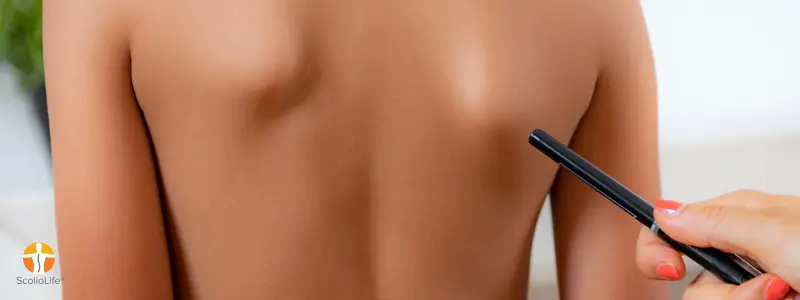
A scoliosis rib hump comes from spinal rotation, not just the Cobb angle, so it can persist even as X-rays improve. Learn what non-surgical care targets.
Your daughter's latest X-ray looks better. The Cobb angle — the number everyone has been watching — has come down, and the relief in the room is real. Then she bends forward to pick up her bag, and there it is again: one side of her back still rises higher than the other. The rib hump you first noticed months ago has not gone anywhere. If this is your experience, you are not imagining it, and you are not doing anything wrong. The rib hump and the Cobb angle are measuring two different things, and they do not always move together.
At ScolioLife®, this is one of the most common sources of confusion — and quiet worry — that families bring to us. Understanding why it happens changes how you monitor scoliosis, what you can reasonably expect from a correction programme, and which parts of care actually matter for the shape you can see in the mirror.
What the rib hump actually is
Scoliosis is often drawn as a simple sideways "S" or "C" curve, as if the spine only bent left and right. It does not. A scoliotic spine also rotates — the vertebrae twist around their vertical axis. Because your ribs attach to those vertebrae, the twist drags the rib cage with it. On one side the ribs are pushed backwards, creating the raised bump you see when the person bends forward. On the other side the chest can look flatter. This rib prominence — clinicians call it the rib hump — is the visible signature of rotation, not of the side-to-side curve alone.
This is why the forward bend reveals it so clearly. Standing upright, the twist can hide. Bending forward lines the ribs up against gravity and lets the asymmetry show. It is exactly the principle behind the screening test used in Singapore schools.
Why the Cobb angle and the rib hump don't move together
The Cobb angle is measured on a flat, two-dimensional X-ray taken from behind. It captures how far the spine deviates sideways. It does not directly capture rotation, and it does not capture the shape of the rib cage at all. Rotation and rib shape are three-dimensional problems living on a two-dimensional measurement.
Research makes this disconnect concrete. In studies following patients after major curve correction, the Cobb angle can improve substantially while the trunk rotation you actually see barely changes. One analysis reported roughly 41% improvement in the Cobb angle but only around 22% improvement in the angle of trunk inclination — the rib hump measure — over the same period, with much of the early surface improvement fading over two years. Other work has found no reliable correlation between changes in vertebral rotation and changes in the Cobb angle at all.
The practical takeaway is uncomfortable but important: a better Cobb angle does not automatically mean a smaller rib hump, and a stubborn rib hump does not automatically mean the curve is getting worse. They are related, but they are not the same number.
What Singapore's screening measures — and what it doesn't
Singapore has run school-based scoliosis screening since 1982. Girls are screened from Primary 5 through Secondary 2, and boys from Secondary 2 to 4. The screen combines a visual check of the back with the Adam's forward bend test, and the rotation is measured with a small device called a scoliometer. A reading of five degrees or more of trunk rotation typically prompts a referral to the Health Promotion Board's Student Health Centre, where an X-ray may follow.
Notice what the school screen is built around: rotation. The scoliometer measures the very rib hump we have been discussing, because rotation is what you can detect early, cheaply and without radiation. Scoliosis is not rare — Singapore figures put its prevalence at roughly 1.4% of girls aged 11 to 12 and around 2.2% of girls aged 13 to 14, with the female-to-male ratio rising sharply through puberty. Many of these curves are small and are simply monitored. But the screening tool itself is a reminder that the rib hump is not a cosmetic afterthought — it is the front-line signal.
The mainstream blind spot
Here is where the ScolioLife® view differs from the way scoliosis is often discussed. Once a curve is in the system, attention frequently narrows to a single number on an X-ray: the Cobb angle. Progress is declared, or worry raised, based almost entirely on it. Dr Kevin Lau's position, built over more than 25 years of non-surgical scoliosis care, is that this is too narrow. The Cobb angle is useful, but it is one slice through a three-dimensional problem. If rotation is what patients see in the mirror, what shows up in photographs, and what the school screen was designed to catch, then rotation deserves to be measured and supported in its own right — not treated as a by-product that will sort itself out once the angle improves.
Most scoliosis articles skip this entirely. They explain the Cobb angle, then imply that reducing it resolves everything the patient is worried about. Families are left surprised and discouraged when the visible asymmetry lingers. The gap is not in the patient's effort; it is in the framing.
What non-surgical care targets when rotation is the problem
If the rib hump is a rotation problem, then a correction programme has to work on rotation specifically. Generic "strengthen your core" advice and symmetrical gym routines struggle here, because they treat both sides of the body the same when the whole point of scoliosis is that the two sides are not the same. The ScolioLife® System is built around this asymmetry. Within it, several elements speak directly to rotation:
- Three-dimensional postural and spinal scanning — so rotation and rib prominence are measured and tracked over time, not just the sideways curve.
- Scoliometer monitoring at every review — the same rotation measure the schools use, repeated consistently so change is visible between visits.
- Curve-specific rotational and breathing exercises — movement and directed breathing aimed at de-rotating the trunk and re-expanding the collapsed side of the rib cage, rather than one-size-fits-all stretches.
- The ScolioAlign® brace — a custom, 3D-scanned, hyper-corrective brace designed to work against rotation as well as the curve, with comfort and ventilation built in so it is actually worn.
- Nutrition and bone-health support — because the spine grows and remodels within a whole body, especially during the growth years when curves are most active.
These are described as clinical goals, not promises. Scoliosis is highly individual, and results vary depending on age, skeletal maturity, curve type, the degree of rotation, how consistently a brace is worn, exercise adherence and each person's biology. The aim is to manage and support the spine — to improve posture, encourage correction and reduce the risk of progression — and to give patients an honest, measured picture of what is changing. No clinic can guarantee a rib hump will disappear, and any that promises this should be treated with caution.
What this means for you between visits
A few practical things follow from understanding rotation:
- Don't judge progress on the Cobb angle alone. Ask for the rotation measurement too, and track both over time.
- Photograph the forward bend, not just standing. A monthly forward-bend photo in the same light and position shows rib-hump change far better than memory.
- Take brace wear seriously. A brace works in proportion to the hours it is worn, and rotation responds to consistency more than to intensity.
- Expect the two numbers to move at different speeds. A rib hump that holds steady while the curve improves is a common pattern, not a failure.
Frequently asked questions
My child's Cobb angle improved but the rib hump looks the same. Is the treatment failing?
Not necessarily. The Cobb angle and the rib hump measure different things — sideways curve versus rotation — and they often change at different rates. A steady rib hump alongside an improving curve is a common pattern. The useful step is to measure rotation directly rather than infer it from the X-ray.
Can a rib hump be reduced without surgery?
Rotation can be monitored and worked on with curve-specific exercises and bracing as part of a structured correction programme, and many patients see meaningful change in posture and rib prominence. Because scoliosis is individual, results vary, and the goal is to support and manage the spine rather than promise a fixed outcome.
Why does the rib hump show up more when bending forward?
Bending forward aligns the rotated ribs against gravity, which exposes the asymmetry that can stay hidden when standing upright. This is exactly why the Adam's forward bend test is used in school screening.
What scoliometer reading is a concern?
In Singapore's school screening, a trunk rotation of five degrees or more usually prompts referral for further assessment. A scoliometer reading is a screening signal, not a diagnosis on its own — an X-ray provides the Cobb angle, and a full assessment puts the two together.
Should I worry more about the curve or the rib hump?
Both matter, for different reasons. The curve tells you about the spine's structure and progression risk; the rib hump reflects rotation and is what tends to affect appearance, breathing mechanics and confidence. Sound scoliosis care monitors and supports both.
Take the next step
Book a consultation with ScolioLife® and learn more about our scoliosis therapy programme.
More articles

Does Scoliosis Make You Shorter? How Much Height a Curve Costs, and What Can Be Regained
November 3, 2026
Is Swimming Good for Scoliosis? What the Research Shows, and What the Pool Can and Cannot Do
October 26, 2026
Scoliosis X-Rays and Radiation: How Many Does Your Child Really Need, and How to Keep the Count Low
October 26, 2026